

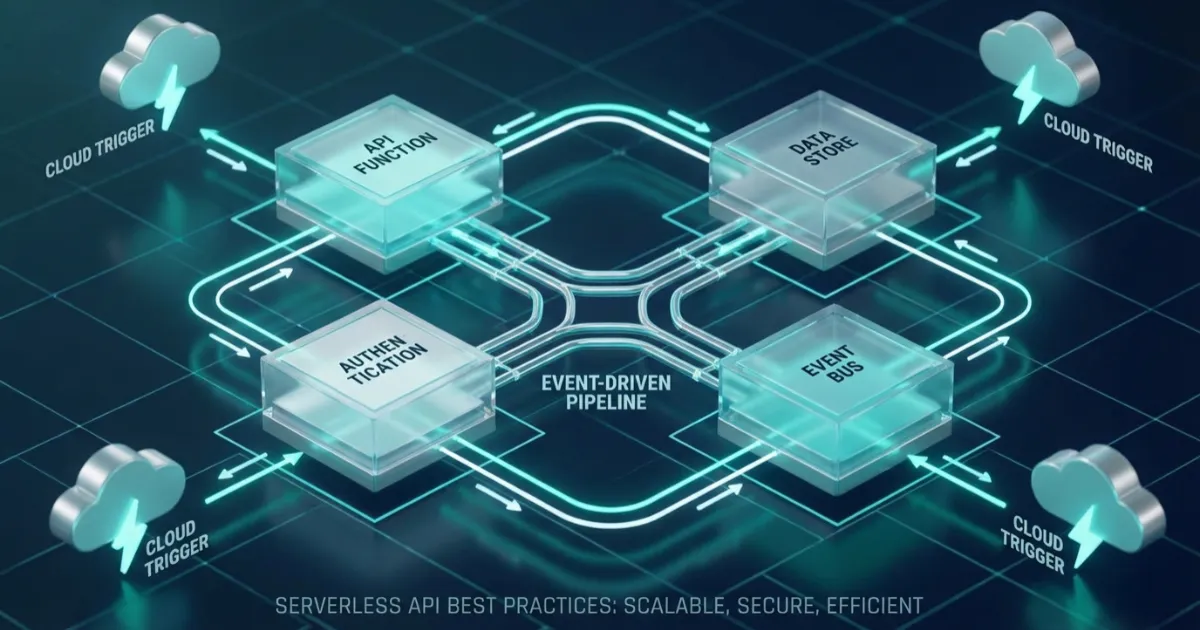
Serverless APIs have completely changed the way we build backend services. In my experience, they’re a game-changer for small teams, rapid prototypes, and even large-scale applications if you design them right. But, just because you deploy something “serverless” doesn’t mean it’s automatically scalable, fast, or cheap. Done poorly, serverless APIs can become costly, slow, and hard to maintain.
At its core, a serverless API lets you expose functionality without worrying about managing the underlying servers. Platforms like AWS Lambda with API Gateway, Azure Functions with Azure API Management, or Google Cloud Functions handle infrastructure, scaling, and maintenance for you. That sounds amazing, but in reality, there are patterns and pitfalls you need to understand.
In this post, I’ll walk you through everything I’ve learned from building, scaling, and troubleshooting serverless APIs. From design principles to security, performance, and real-world anti-patterns you’ll get the practical know-how to make serverless APIs work in production.
What is a Serverless API?
A serverless API is simply an API built on serverless functions, usually triggered by HTTP requests or events. Unlike traditional APIs running on dedicated servers or containers, serverless APIs scale automatically, you only pay for execution time, and you don’t manage infrastructure.
In practical terms:
-
Function-as-a-Service
is at the heart. AWS Lambda, Azure Functions, or Google Cloud Functions run small, stateless pieces of code in response to triggers.
-
API Gateway
acts as the front door. It maps HTTP requests to the right function, handles authentication, and can enforce throttling.
-
Event-driven
patterns are common. You might trigger a function from an S3 upload, a message in a queue, or a scheduled task.
Real-world difference? In a traditional REST API, you’d spin up a Node.js app on EC2 or a container, and it runs 24/7. With serverless, the function only runs when invoked. That’s huge for cost efficiency but can introduce cold starts more on that later.
For example, imagine a simple “upload profile picture” API. In a traditional setup, your server handles the request, processes the image, and saves it.
In serverless, the API Gateway routes the request to a Lambda function, which processes the image and stores it in S3 only running code when needed.
Core Principles of Serverless API Design
From experience, the most important thing in serverless is thinking differently. Treat each function like a building block, not a mini-server.
Statelessness
Serverless functions should never rely on local state. Each invocation could happen on a completely new container. If your function reads a file from assuming it persists between runs, you’ll get burned. Store state externally DynamoDB, Redis, or S3.
Function granularity
Smaller functions are better. One function per API endpoint or logical operation works best. I’ve seen functions doing too much fetching users, processing data, sending emails all in one. They’re slow to deploy, hard to debug, and prone to failure. Split them into focused units.
Modularity
Reusable modules matter. For example, authentication, logging, or input validation can be abstracted into shared packages. Keep your code DRY but don’t create dependencies that break cold starts or make deployment heavy.
API Gateway and Routing Patterns
The API Gateway is more than a router; it’s the traffic cop for your serverless API. You need to understand what patterns work best:
-
REST APIs
Traditional endpoints like Easy to reason about and widely supported.
-
HTTP APIs
A simpler, cheaper alternative (AWS API Gateway HTTP APIs). Less feature-rich but faster and cheaper.
-
WebSocket APIs
For real-time apps like chat or notifications. Serverless can handle connections, but managing scaling and state across ephemeral connections can be tricky.
Integration styles also matter:
-
Proxy integration
API Gateway forwards everything to a Lambda function, which handles routing internally. Simple, but your function grows if you have many endpoints.
-
Microservice style
Each function handles a single endpoint. Cleaner, easier to scale, but more deployment units to manage.
A mini diagram in text:
HTTP methods & status codes
Use the correct verbs: GET, POST, PUT, DELETE. Return meaningful status codes (200, 201, 400, 404, 500). Avoid always returning 200 with an error message inside this kills monitoring and debugging.
Input validation
Never trust client input. Validate requests at the edge (API Gateway) and inside the function. I’ve seen APIs break because malformed JSON or missing fields crashed the function.
Caching strategies
Use API Gateway caching or a CDN like CloudFront to cache GET responses. For dynamic endpoints, consider caching DB query results in Redis. Cache wisely too much cache can serve stale data, too little cache wastes resources
Performance Optimization
Serverless has quirks that traditional servers don’t:
Cold starts
A cold start happens when a function hasn’t run in a while, and the platform spins up a new container. For small Node.js functions it’s fast (<100ms), but heavy Python or Java functions can take seconds.
Mitigation strategies:
-
Keep functions lean (small packages).
-
Avoid heavy dependencies on startup.
-
Consider “warming” functions with scheduled pings (though not always cost-effective).
Resource utilization
Set memory and CPU wisely. Lambda lets you scale CPU with memory. I’ve seen devs leave functions at 128MB and wait 5 seconds for a DB call increasing memory cut runtime in half and reduced cost!
Monitoring for bottlenecks
Track duration, memory, and invocation count. AWS CloudWatch, X-Ray, or open-source tools like OpenTelemetry are lifesavers.
Security Best Practices
Serverless isn’t automatically secure. These are the must-dos I’ve learned:
Authentication & authorization
Use API Gateway authorizers or JWT tokens. Never bake secrets into functions. AWS Cognito, Auth0, or custom JWT validation work well.
Least privilege
Functions should have only the permissions they need. If a function only reads from S3, don’t give it write access. I’ve seen breaches where one over-permissioned Lambda led to leaked data.
Data protection
Encrypt sensitive data at rest and in transit. Serverless often touches cloud storage enforce encryption keys and HTTPS.
Rate limiting & throttling
Prevent abuse with API Gateway throttling. Serverless scales automatically, but you can still hit DB or third-party rate limits.
Dependency management
Vulnerable packages are a major attack vector. Keep dependencies minimal and regularly scan for CVEs.
Monitoring, Observability & Logging
You can’t fix what you don’t see. Logging and monitoring in serverless are slightly different:
-
Use structured logs (JSON) to make aggregation easy.
-
Enable distributed tracing (X-Ray, OpenTelemetry) to see end-to-end requests.
-
Track key metrics: latency, error rate, and invocation count.
A small tip: log only what you need. Logging everything can explode costs in serverless environments.
Error Handling & Resiliency
Serverless functions are ephemeral they fail sometimes:
-
Retry strategies
Lambda supports automatic retries. Be careful with non-idempotent operations (like charging a card).
-
Fallback paths
If your DB is down, return cached data or a friendly error.
-
Circuit breakers
Don’t hammer downstream services when they’re failing.
In my experience, a function without retries or fallbacks will fail silently in production very painful.
Cost Management
Serverless is cheap if used smartly:
-
Monitor invocations and duration.
-
Right-size memory for function performance vs cost.
-
Set alerts for unexpected spikes (a sudden bug could cost hundreds of dollars).
CI/CD and Deployment Automation
Serverless APIs benefit hugely from automation:
-
Use Infrastructure as Code: AWS SAM, Serverless Framework, or Terraform.
-
CI/CD pipelines should deploy functions, run unit/integration tests, and roll back on failure.
-
Automated testing catches cold start issues, config errors, and mis-routed endpoints before production.
Common Anti-Patterns to Avoid
Some things will bite you if ignored:
-
Monolithic functions
Doing everything in one Lambda = pain. Split logic.
-
Long-running processes
Functions are meant for short-lived tasks. Use Step Functions for longer workflows.
-
Shared state
Never store temporary expecting it to persist. Always externalize state.
You Might Be Interested In
- Serverless Computing Explained With Real Examples
- Hybrid Cloud Architecture For Beginners
- Cloud Computing For Beginners: Simple Explanation + Examples
- Aws Lambda Cold Starts: Causes And Fixes
- Azure Functions Vs Aws Lambda: Practical Comparison
Conclusion
Designing serverless APIs isn’t just about writing a function and deploying it. It’s about thinking differently embracing statelessness, splitting responsibilities into focused functions, and planning for performance, security, and costs from the start. In my experience, teams that treat serverless as “just another server” end up with slow, costly, and hard-to-maintain APIs.
The key is iteration. Start small, monitor closely, optimize gradually, and refactor when needed. Use the best practices we’ve discussed clean endpoint design, proper error handling, performance tuning, and strong security to make your APIs reliable and scalable. With careful design and ongoing attention, serverless architecture can truly unlock the benefits of automatic scaling, lower operational overhead, and faster time-to-market.
FAQs
Do serverless APIs always cost less than traditional servers?
Not necessarily. While serverless APIs charge you only for actual execution time, that doesn’t automatically make them cheaper. If you have an API that’s invoked thousands or millions of times per day, or one that performs heavy computation on each request, the costs can add up quickly sometimes exceeding what you’d pay for a container running continuously.
In my experience, small, intermittent workloads are where serverless shines. But for predictable, high-volume workloads, it’s important to model costs carefully. Monitoring execution duration, memory usage, and request volume is crucial, and you may need to combine serverless with other solutions to optimize spending.
How do I handle database connections in serverless functions?
Database connections can be tricky in serverless environments. Each function invocation may spin up a new instance, which can quickly exhaust connection limits if you’re using traditional relational databases. I’ve seen Lambda functions fail repeatedly because they opened hundreds of new connections during a traffic spike.
To handle this, use connection pooling, serverless-friendly databases like Aurora Serverless, or managed database pools that can handle bursts. Another strategy is to batch requests when possible or offload certain operations to a queue, ensuring your functions remain lightweight and your database isn’t overwhelmed.
Are serverless functions suitable for high-performance workloads?
Yes, but there are limitations. Serverless functions are designed for short-lived, event-driven tasks, and while they scale automatically, CPU-heavy or long-running processes can run into issues. Cold starts and memory limits can add latency or even prevent functions from completing within the allowed execution time.
In practice, I’ve found that workloads like image processing, video transcoding, or complex analytics often benefit from hybrid architectures. You can use serverless for lightweight triggers and orchestration while offloading the heavy processing to containers, batch jobs, or dedicated high-performance services. The key is to know the boundaries of serverless performance.
Can I use serverless APIs for real-time applications?
You can, but it’s not always straightforward. WebSocket APIs are supported in serverless environments and can handle real-time messaging, but maintaining state across ephemeral, short-lived functions can be challenging. Connections may drop or need re-authentication, and scaling real-time connections can put pressure on downstream resources.
In my experience, combining serverless functions with persistent services, like managed WebSocket servers or in-memory databases, gives the best of both worlds. Serverless can handle authentication, message routing, and event triggers, while the persistent layer maintains active sessions and state reliably. It’s a hybrid approach that balances scalability with stability.
How do I debug serverless APIs in production?
Debugging serverless APIs requires a different mindset compared to traditional servers. You can’t just SSH into a container or attach a debugger, because the function may not even be running when you want to inspect it. Structured logging, distributed tracing, and staging environments become critical tools for understanding behavior in production.
From my experience, CloudWatch Logs, AWS X-Ray, or OpenTelemetry are lifesavers. You can trace requests end-to-end, inspect latency, and correlate errors across multiple functions. The key is to instrument your functions properly before deployment, avoid relying on print statements, and always test complex flows in a staging environment to catch issues before they hit production.
