

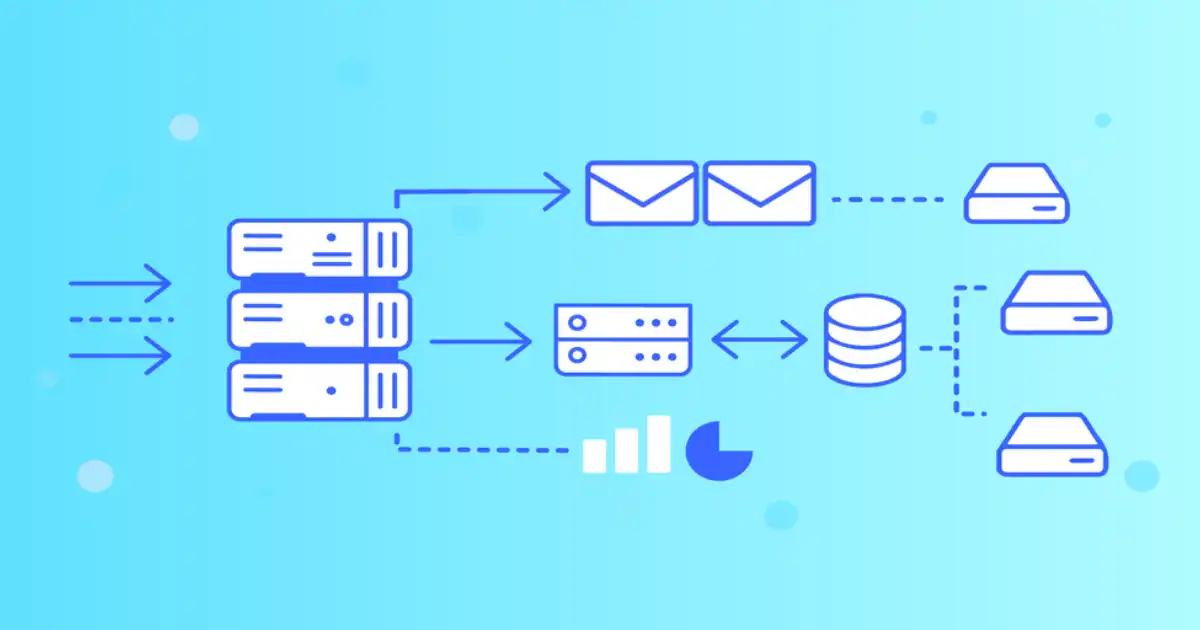
When people first hear the term software architecture design, they often imagine complicated diagrams full of boxes, arrows, and technical jargon.
In practice, it’s much simpler than that.
Software architecture design is the process of deciding how a software system will be structured so it can solve real business problems reliably over time.
Think of it as making the big decisions before thousands or millions of lines of code are written.
Questions like:
- How will different parts of the system communicate?
- Where will data be stored?
- How will the application handle growth?
- What happens when one component fails?
- How will developers work on the system without stepping on each other’s toes?
These are architecture questions.
In my experience, architecture is less about diagrams and more about making good trade-offs.
A junior developer might focus on writing a feature.
An architect thinks about what happens six months later when that feature interacts with fifty others.
Good architecture helps teams move faster.
Bad architecture slows everyone down.
The interesting part is that users never see architecture directly.
They only experience the results.
Fast systems usually have thoughtful architecture.
Slow, unreliable systems often reveal architectural problems that have been ignored for years.
Why Software Architecture Design Actually Matters
Many small applications seem fine without much architectural planning.
Then the user base grows.
New developers join.
Features increase.
Deadlines become tighter.
That’s when architecture starts mattering.
I’ve seen projects that worked perfectly with ten users collapse under a thousand users because nobody thought about scalability.
I’ve also seen teams spend months building overly complex architectures for products that never gained traction.
Both extremes are mistakes.
Good architecture helps solve problems like:
- System growth
- Team collaboration
- Reliability
- Performance
- Security
- Maintainability
Imagine an e-commerce platform.
Initially, handling 100 daily orders is easy.
Now imagine handling 100,000 daily orders.
The architecture decisions made early suddenly become critical.
Database bottlenecks appear.
Slow APIs emerge.
Background jobs pile up.
Without a solid architectural foundation, every new feature becomes harder to build.
The biggest value of architecture is not making systems work today.
It’s making sure they still work tomorrow.
Key Components of Software Architecture
Modules and Components
Every software system consists of smaller parts.
These parts are often called modules or components.
For example, an online store might have:
- User management
- Product catalog
- Shopping cart
- Payments
- Order processing
Keeping responsibilities separate makes systems easier to understand and maintain.
One common mistake is allowing modules to depend heavily on each other.
When that happens, changing one area breaks three others.
I’ve spent more time fixing dependency problems than writing new features in some legacy systems.
Good architecture creates clear boundaries.
Data Flow
Data flow describes how information moves through a system.
For example:
User → Web Application → API → Database
Simple systems often have straightforward flows.
As systems grow, data may move through:
- Message queues
- Caches
- Multiple services
- Analytics platforms
Understanding data flow becomes critical when troubleshooting performance issues.
Many production problems can be traced back to poor visibility into how data travels.
Communication Between Services
Modern systems rarely consist of a single application.
Services communicate constantly.
Common communication methods include:
- REST APIs
- GraphQL
- Message queues
- Event streams
Choosing the wrong communication approach can create bottlenecks.
Synchronous communication is easy to understand but can create delays.
Asynchronous communication improves resilience but increases complexity.
Every choice comes with trade-offs.
Layers in a System
Many systems separate responsibilities into layers.
Typical layers include:
- Presentation layer
- Business logic layer
- Data access layer
- Database layer
The goal is separation of concerns.
When layers become mixed together, maintenance becomes painful.
I’ve seen business logic hidden inside database queries and UI code performing database operations directly.
Those shortcuts eventually become expensive.
Types of Software Architecture Design
Monolithic Architecture
A monolith is a single deployable application containing all functionality.
People often criticize monoliths, but they’re not inherently bad.
For startups and small teams, monoliths can be extremely productive.
Advantages:
- Simple deployment
- Easier debugging
- Lower operational complexity
Problems appear when:
- Teams become large
- Deployments become risky
- Scaling needs differ across modules
A monolith can serve a business successfully for years if designed carefully.
Microservices Architecture
Microservices split functionality into independent services.
Examples:
- Payment service
- User service
- Inventory service
This approach offers flexibility and scalability.
However, many teams underestimate the complexity.
What most people miss is that microservices replace application complexity with operational complexity.
Now you need:
- Service discovery
- Monitoring
- Distributed tracing
- Network management
- Versioning strategies
I’ve seen startups with five developers adopt microservices and spend more time managing infrastructure than building products.
Client-Server Architecture
This is one of the most common architectures.
Clients send requests.
Servers process them.
Examples include:
- Websites
- Mobile apps
- Desktop applications connected to backends
It’s straightforward and works well for many systems.
The challenge is ensuring the server can handle increasing demand efficiently.
Event-Driven Architecture
In event-driven systems, components react to events rather than direct requests.
Example:
An order is placed.
Events are published.
Other systems react:
- Inventory updates
- Shipping starts
- Emails are sent
- Analytics records data
This architecture scales well and improves flexibility.
The downside is increased complexity during debugging.
Tracing issues across multiple events can be challenging.
Layered Architecture
Layered architecture organizes systems into logical layers.
It remains popular because it’s easy to understand.
The danger is creating too many layers.
I’ve seen systems where a simple request passes through seven layers before reaching the database.
That often signals unnecessary complexity.
Software Architecture Principles That Actually Matter in Practice
Scalability
Scalability is not about handling huge traffic today.
It’s about avoiding painful redesigns later.
Architecture should allow growth without complete rewrites.
That doesn’t mean preparing for a billion users on day one.
It means making reasonable decisions that won’t trap future development.
Maintainability
Most software spends far more time being maintained than built.
Future developers should understand the system without needing archaeology skills.
Readable architecture reduces costs dramatically.
Coupling and Cohesion
Good systems keep related functionality together while minimizing dependencies.
High coupling creates fragility.
A change in one component causes unexpected failures elsewhere.
High cohesion keeps responsibilities focused.
Modules should do one thing well.
Performance Trade-Offs
Performance is always a balancing act.
Faster systems often require:
- More infrastructure
- More complexity
- More engineering effort
Blindly optimizing everything is rarely useful.
Optimize where real bottlenecks exist.
Simplicity vs Flexibility
This is one of the hardest architectural decisions.
Simple systems are easier to maintain.
Flexible systems support future changes.
The challenge is finding the right balance.
In many cases, simplicity wins.
Future requirements are often wrong.
Common Architecture Pattern
MVC
Model-View-Controller remains popular because it’s easy to understand.
Many developers misuse MVC by putting all business logic into controllers.
Controllers become massive and difficult to maintain.
MVC works best when responsibilities remain separated.
CQRS
Command Query Responsibility Segregation separates reads from writes.
CQRS can improve performance and scalability.
The mistake is adopting it unnecessarily.
Many applications work perfectly with standard CRUD operations.
CQRS introduces complexity that must be justified.
Clean Architecture
Clean Architecture emphasizes separation of concerns and independence from frameworks.
The principles are valuable.
The misuse occurs when teams create excessive abstraction.
I’ve seen simple applications buried under layers of interfaces that added no practical value.
Microkernel
Microkernel architecture supports plugins and extensions.
Operating systems and extensible platforms often benefit from this approach.
The mistake is implementing plugin systems where none are needed.
Flexibility is useful only when real extension requirements exist.
Role of a Software Architect in Real Teams
Many people imagine architects spending their days drawing diagrams.
Reality looks different.
A software architect spends significant time making decisions under constraints.
There is rarely a perfect solution.
Instead, architects balance:
- Budget
- Time
- Team skills
- Business goals
- Technical risks
Communication is a huge part of the role.
An architect who cannot explain decisions clearly creates confusion.
Another overlooked responsibility is production accountability.
Architecture decisions eventually meet reality.
Traffic spikes.
Servers fail.
Databases slow down.
Architects must understand those consequences.
Good architects stay connected to real systems, not just design documents.
Real-World Examples of Architecture Decisions
Netflix-Style Scaling Problems
Netflix serves enormous amounts of content globally.
A monolithic system would struggle at that scale.
Microservices help isolate responsibilities and scale independently.
However, Netflix also invests heavily in tooling, monitoring, and reliability engineering.
Many companies copy the architecture but forget the supporting ecosystem.
E-Commerce Systems
An online store faces predictable architectural challenges:
- Product browsing
- Inventory tracking
- Payments
- Order fulfillment
Inventory consistency becomes critical.
Overselling products damages customer trust.
Architecture decisions around databases and transaction handling directly affect business outcomes.
Banking Systems
Banking systems prioritize reliability and consistency.
A payment cannot simply disappear because a service restarted.
Architectural choices emphasize:
- Data integrity
- Auditability
- Security
- Fault tolerance
Performance matters, but correctness matters more.
A fast incorrect transaction is worse than a slower correct one.
Common Mistakes in Software Architecture Design
Overengineering Early Systems
One of the most common mistakes is designing for hypothetical future requirements.
Teams build complexity they never use.
The result is slower development and higher maintenance costs.
Choosing Microservices Too Early
Microservices are powerful.
They’re also expensive.
Small teams often gain more from a well-structured monolith.
Splitting services prematurely creates operational burdens.
Ignoring Future Scaling Needs
The opposite mistake also happens.
Some systems are built with no consideration for growth.
Then success arrives and the architecture becomes a bottleneck.
Reasonable planning is important.
Extreme planning is not.
Tight Coupling
Tightly coupled systems become difficult to change.
Every modification creates risk.
Over time, developers become afraid to touch the code.
That’s usually a warning sign of architectural debt.
You Might Be Interested In
- How Ai Secures The Future Of Autonomous Vehicles?
- What Are The Three Types Of Expert Systems?
- Can PII Inside Logs Break AI Compliance?
- AI Mastery 2023: The Authoritative adventure of Narrow Vs Generative AI Spectrum
- What Is Ai-assisted Clinical Decision Support And How Does It Work?
Conclusion
Software architecture design is ultimately about making smart decisions before complexity becomes overwhelming.
The best architectures are rarely the most sophisticated ones. They’re the ones that solve today’s problems while leaving room for tomorrow’s growth.
In my experience, successful architecture comes from understanding trade-offs, not chasing trends. A simple monolith can outperform a poorly implemented microservices platform. A carefully designed system can survive years of growth, while an overengineered one can become a burden from day one.
The goal is not architectural perfection.
The goal is building systems that developers can understand, maintain, and evolve as real-world requirements change. That mindset matters far more than any diagram, pattern, or technology choice.
FAQs
What is software architecture design in simple words?
Software architecture design is basically how you organize a software system so all its parts work together in a clean and reliable way. In simple terms, it’s the blueprint that decides how the application is structured before heavy coding starts. It defines where the main logic lives, how different modules communicate, and how data moves through the system.
In real-world terms, it’s less about drawing diagrams and more about preventing chaos later. If you don’t think about architecture early, you usually end up with a system where everything depends on everything else, and even small changes become risky. Good architecture keeps things understandable as the system grows, so developers can add features without breaking unrelated parts.
Is software architecture the same as software design?
No, they are related but not the same thing. Software architecture focuses on the big picture, like how the system is divided into major components, how they communicate, and what technologies or structures are used at a high level. It’s about shaping the overall system and making key decisions that are hard to change later.
Software design, on the other hand, goes deeper into how individual components are built internally. It deals with class structures, functions, logic flow, and implementation details. In practice, architecture sets the boundaries and rules, while design fills in what happens inside those boundaries. One defines the system structure, the other defines how each part actually works.
Which architecture is best for large systems?
There is no single “best” architecture for all large systems. What works depends heavily on the type of product, team size, and operational needs. Many large systems today use microservices because they allow different parts of the system to scale independently and be developed by separate teams.
However, in real-world engineering, I’ve seen modular monoliths perform just as well or even better in many cases. The mistake is assuming large systems must automatically mean microservices. Large systems need clarity, stability, and good separation of concerns. Sometimes a well-structured monolith with clear boundaries is easier to maintain than a distributed system full of network complexity.
Why is software architecture important?
Software architecture is important because it determines how easily a system can grow, change, and survive real-world usage over time. Without a good architecture, even simple features become difficult to implement because everything in the system is tightly connected. That usually leads to bugs, slow development, and frustration in teams.
In practice, architecture is what keeps a system stable when pressure increases. When traffic grows, when teams expand, or when requirements change, the architecture decides whether you can adapt smoothly or whether you need to rebuild large parts of the system. It directly affects performance, reliability, and long-term development cost, even if users never see it directly.
What problems happen if software architecture is done poorly?
Poor software architecture usually shows up slowly, not all at once. At first, everything feels fine because the system is small and easy to manage. But as new features are added, the structure starts to break down, and developers begin to spend more time fixing unexpected side effects than building new functionality.
In real systems, this often leads to tightly coupled code where one change breaks multiple unrelated features. Performance issues also become harder to solve because there is no clear separation of responsibilities. Eventually, teams either slow down significantly or start rewriting large parts of the system, which is expensive and risky.
