

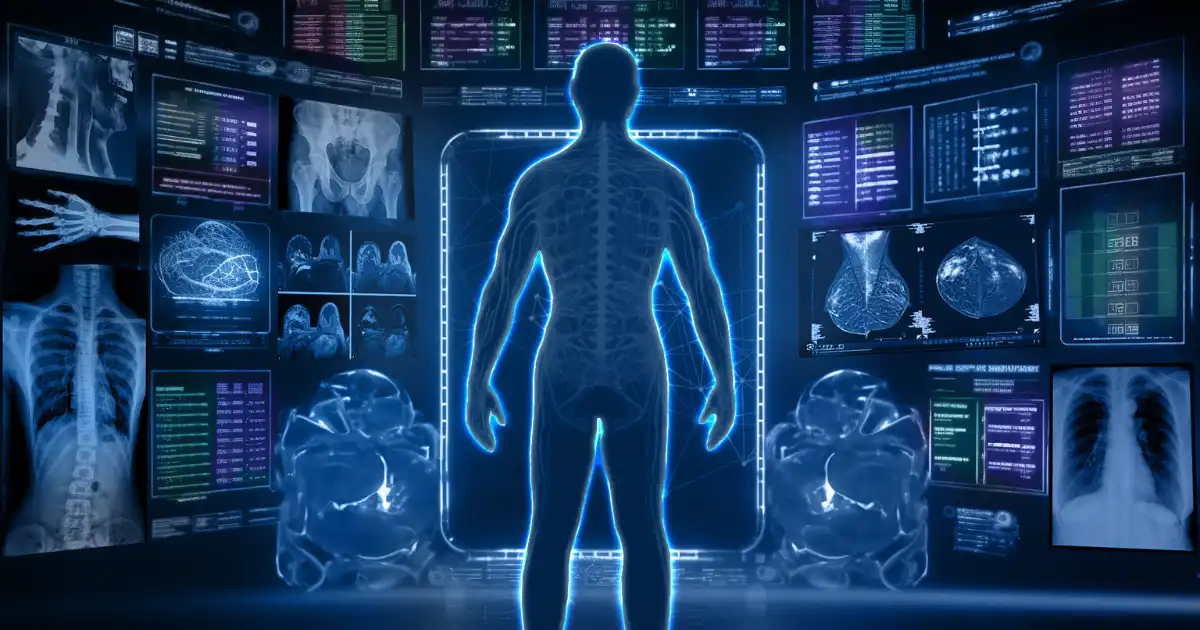
Medical Imaging Diagnosis is one of the most critical parts of modern healthcare. Doctors rely on X-rays, CT scans, and MRI images to detect diseases early, confirm conditions, and plan treatments. Today, AI in medical imaging is changing how these images are analyzed, making diagnosis faster, more accurate, and more consistent. How Is Ai Used In Medical Imaging Diagnosis x-ray, Ct, Mri?
In the past, radiologists manually examined every image. This process required years of training and deep focus, yet it was still limited by human fatigue and time pressure. With the rise of artificial intelligence in radiology, computers can now support doctors by spotting patterns that are difficult to see with the human eye.
This comprehensive guide explains how AI-powered medical diagnosis works in X-ray, CT, and MRI imaging. You will learn how machine learning in medical imaging and deep learning for radiology improve accuracy, reduce workload, and support better patient care. The content is written in simple language, making it easy to understand for a 12th-grade audience.
AI in Medical Imaging Diagnosis
AI in medical imaging refers to computer systems that analyze medical images using advanced algorithms. These systems are trained on thousands or even millions of images. Over time, they learn how healthy and unhealthy tissues look.
Medical Imaging Diagnosis with AI does not replace doctors. Instead, it assists them by highlighting areas of concern. This collaboration improves decision-making and reduces diagnostic errors.
The core idea behind AI-based imaging analysis is pattern recognition. AI systems compare new images with past data. If a scan matches known disease patterns, the system alerts the radiologist.
How Artificial Intelligence in Radiology Works
Data Collection and Training
For machine learning in medical imaging, large datasets are essential. Hospitals provide anonymized X-ray, CT, and MRI scans. Each image is labeled by experts.
AI models learn by reviewing these images repeatedly. Over time, the system understands subtle differences between normal and abnormal scans.
Deep Learning for Radiology
Deep learning for radiology uses neural networks inspired by the human brain. These networks have multiple layers that process image details step by step.
This approach allows AI to detect tiny abnormalities, such as small tumors or early tissue changes. These details are sometimes missed during manual review.
Continuous Improvement
Once deployed, AI-powered medical diagnosis systems continue to learn. As new images are added, the models become more accurate. This ongoing improvement makes AI especially valuable in medical imaging diagnosis.
AI in X-Ray Imaging Diagnosis
Role of AI in X-ray Analysis
X-rays are one of the most common imaging tools. They are quick, affordable, and widely available. AI in medical imaging helps analyze chest X-rays, bone scans, and dental images.
AI systems can detect fractures, infections, and lung diseases within seconds. This speed is crucial in emergency situations.
Common Use Cases
Artificial intelligence in radiology is often used to identify pneumonia, tuberculosis, and lung cancer in chest X-rays. During global health emergencies, AI has helped screen large populations quickly.
In bone imaging, AI-based imaging analysis can detect hairline fractures that are difficult to spot manually.
Benefits of AI in X-ray Diagnosis
AI improves consistency in medical imaging diagnosis. It reduces the risk of missed findings and supports junior radiologists by offering a second opinion.
AI in CT Scan Medical Imaging Diagnosis
Why CT Scans Matter
CT scans provide detailed cross-sectional images of the body. They are essential for detecting tumors, internal bleeding, and organ damage.
Because CT scans generate hundreds of images, reviewing them manually takes time. AI-powered medical diagnosis speeds up this process.
Machine Learning in Medical Imaging for CT
Machine learning in medical imaging allows AI to analyze CT scans layer by layer. The system identifies abnormal shapes, densities, and patterns.
AI can detect early signs of cancer, stroke, and cardiovascular disease. This early detection improves survival rates.
Emergency and Critical Care
In emergencies, time is critical. AI in medical imaging can flag life-threatening conditions such as brain hemorrhage within minutes. This helps doctors act quickly.
AI in MRI Medical Imaging Diagnosis
Understanding MRI Scans
MRI scans use magnetic fields to create detailed images of soft tissues. They are commonly used for brain, spine, and joint examinations.
MRI images are complex, making them ideal for deep learning for radiology applications.
AI-Based Imaging Analysis in MRI
AI-based imaging analysis helps detect neurological disorders, tumors, and muscle injuries. AI can measure tissue changes over time, which is useful for monitoring chronic conditions.
In brain imaging, artificial intelligence in radiology supports early diagnosis of diseases like Alzheimer’s and multiple sclerosis.
Improving Accuracy and Consistency
MRI interpretation varies between radiologists. AI-powered medical diagnosis reduces this variation, ensuring more consistent medical imaging diagnosis.
Benefits of AI in Medical Imaging Diagnosis
Faster Diagnosis
AI processes images in seconds. This speed helps reduce waiting times for patients and supports faster treatment decisions.
Higher Accuracy
By analyzing vast amounts of data, AI in medical imaging reduces human error. It detects patterns that may be overlooked.
Reduced Workload for Radiologists
Radiologists face increasing workloads. Artificial intelligence in radiology handles repetitive tasks, allowing doctors to focus on complex cases.
Early Disease Detection
Early diagnosis saves lives. Machine learning in medical imaging identifies diseases at an early stage, improving patient outcomes.
Challenges and Limitations of AI in Medical Imaging
Data Quality Issues
AI systems depend on high-quality data. Poor image quality can affect medical imaging diagnosis accuracy.
Bias in AI Models
If training data lacks diversity, AI-powered medical diagnosis may perform poorly for certain populations. Addressing bias is essential.
Integration with Clinical Workflow
Hospitals must integrate AI-based imaging analysis smoothly into existing systems. Poor integration can limit benefits.
Ethical and Legal Concerns
Doctors remain responsible for final decisions. Artificial intelligence in radiology must be used carefully to avoid over-reliance.
Role of Radiologists in the Age of AI
AI does not replace radiologists. Instead, it changes their role. Doctors become decision-makers who interpret AI results in clinical context.
Medical imaging diagnosis improves when human expertise and deep learning for radiology work together.
Radiologists also play a key role in training and validating AI systems. Their feedback ensures safe and effective use.
Future of AI in Medical Imaging Diagnosis
Personalized Medicine
AI in medical imaging will support personalized treatment plans. Imaging data combined with patient history will improve care.
Real-Time Imaging Analysis
Future systems will provide instant feedback during scans. This will enhance AI-powered medical diagnosis accuracy.
Global Healthcare Access
AI tools can support remote areas with limited specialists. Machine learning in medical imaging can bring quality diagnosis to underserved regions.
You Might Be Interested In
- What Is Epoch In Machine Learning?
- Why Is A Code Review Process Important?
- How To Search On Poe Ai?
- AI in Fraud Detection: Enhancing Security and Efficiency
- Top 7 Ai Architects Designing Saudi’s Linear City
- How Do You Write an AI Acceptable Use Policy That Employees Can Follow?
- How Do Companies Migrate To The Cloud Step By Step?
- What Is a Convolutional Neural Network?
- When Does Accuracy Hide Model Errors on Imbalanced Data?
- How Does Ai Dungeon Work?
Conclusion
Medical Imaging Diagnosis is entering a new era with the rise of AI in medical imaging. From X-rays to CT scans and MRIs, artificial intelligence in radiology is transforming how diseases are detected and managed.
AI-powered medical diagnosis improves speed, accuracy, and consistency. Through machine learning in medical imaging and deep learning for radiology, healthcare providers can detect diseases earlier and treat patients more effectively.
While challenges remain, the collaboration between doctors and AI-based imaging analysis offers immense promise. The future of medical imaging diagnosis lies in combining human expertise with intelligent technology to deliver better healthcare for everyone
FAQs about Ai Used In Medical Imaging Diagnosis
Is AI replacing radiologists in medical imaging diagnosis?
AI is not replacing radiologists, and it is not designed to do so. Instead, AI in medical imaging works as a powerful support system that assists radiologists in analyzing images more efficiently. Radiologists bring clinical experience, patient history understanding, and critical thinking that AI cannot replicate. Artificial intelligence in radiology helps by highlighting suspicious areas, reducing oversight, and acting as a second reader.
In real-world practice, medical imaging diagnosis becomes stronger when humans and AI work together. Radiologists review AI suggestions, confirm findings, and make the final medical decision. This collaboration improves accuracy while keeping human judgment at the center of patient care.
How accurate is AI-powered medical diagnosis?
The accuracy of AI-powered medical diagnosis is often very high, especially for specific and well-defined tasks such as detecting tumors, fractures, or lung infections. In many studies, machine learning in medical imaging has shown performance comparable to experienced radiologists when trained on high-quality and diverse datasets.
However, AI accuracy depends on data quality, proper validation, and real-world testing. Medical imaging diagnosis still requires human oversight to interpret results in context. AI improves reliability and consistency, but final responsibility remains with trained medical professionals.
Can AI analyze all types of medical images?
Yes, AI-based imaging analysis can be applied to many types of medical images, including X-rays, CT scans, and MRI scans. Each imaging type benefits differently from AI due to its unique characteristics. For example, X-rays benefit from fast screening, while MRI scans benefit from detailed tissue analysis using deep learning for radiology.
As AI in medical imaging continues to advance, its ability to analyze more complex images improves. While AI is already widely used across major imaging types, ongoing development is expanding its use into newer and more specialized imaging techniques.
What are the risks of artificial intelligence in radiology?
One major risk of artificial intelligence in radiology is data bias. If AI systems are trained on limited or unbalanced datasets, their performance may vary across different populations. This can affect the fairness and reliability of medical imaging diagnosis in real clinical settings.
Another concern is over-reliance on AI results. AI-powered medical diagnosis should always be reviewed by qualified professionals. Ethical use, continuous monitoring, and proper training help ensure AI remains a supportive tool rather than a replacement for human expertise.
Will AI improve access to healthcare?
Yes, AI in medical imaging has strong potential to improve healthcare access, especially in regions with limited medical specialists. Machine learning in medical imaging can assist clinics and hospitals that lack experienced radiologists by providing fast and reliable image analysis.
By supporting early and accurate medical imaging diagnosis, AI helps reduce delays in treatment. This technology can also enable remote diagnosis and telemedicine, making quality healthcare more accessible to underserved and rural populations.
