

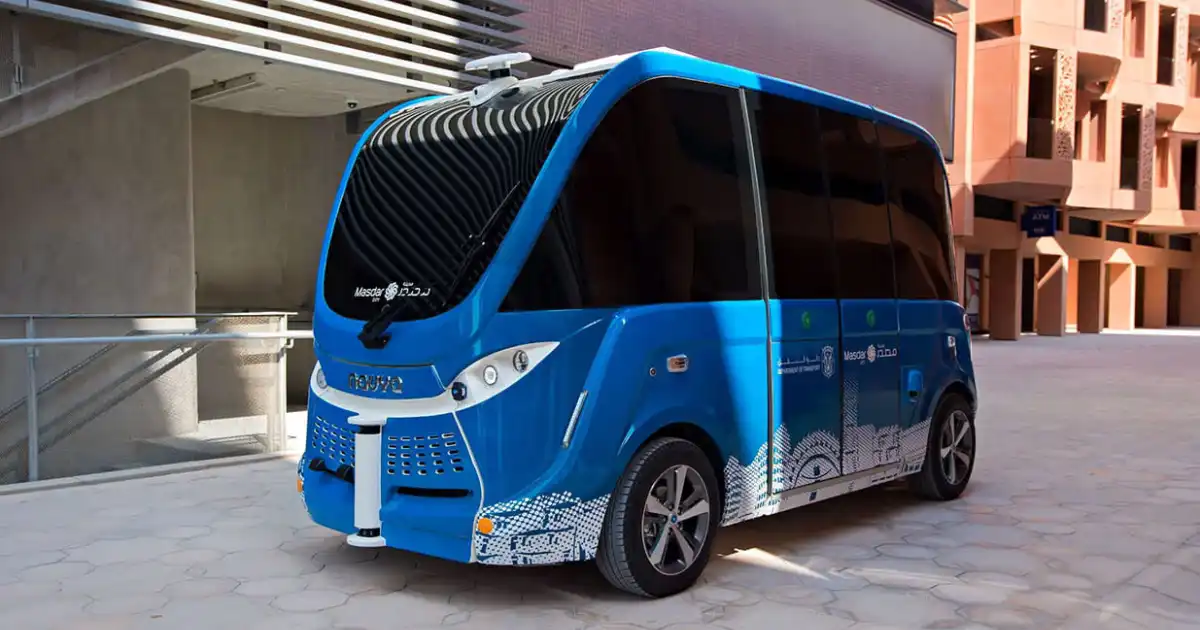
Masdar City gets talked about like it’s a sci-fi set: little pods, driverless shuttles, silent buses, clean streets. Some of that reputation is earned. Some of it is… let’s say “marketing with a good camera angle.”
I’ve spent enough time around EV fleets and autonomy pilots to know the difference between a system that looks great on opening day and one that holds up on a dusty Thursday when the temperature is rude, a sensor is slightly out of calibration, and people behave like people (read: unpredictably). Masdar is interesting because it’s been used as a living testbed not just a concept for multiple mobility ideas that most cities try to bolt on later.
In this piece, I’ll walk you through what each transport mode is actually doing, what technology powers it, why that tech makes sense for a controlled district, and where the practical friction shows up: charging logistics, thermal management, cleaning cycles, geofencing constraints, pedestrian edge cases, and the reality that autonomy isn’t “a robot driver,” it’s a carefully fenced operating envelope.
If you want a clean mental model of Masdar City transport technologies what’s real, what’s fragile, and what other smart cities can reuse you’re in the right place.
Masdar City’s Mobility Approach in One Minute (180–220)
Masdar’s transport philosophy is basically: reduce car dependency inside the district, then support movement with a mix of walkability, micromobility, and electrified shared transport.
Instead of assuming everyone will drive to every door, the city design leans on shorter trip distances, shaded walkways, and a network approach: different modes solve different trip types.
-
PRT pods
Personal Rapid Transit cover a very specific “last-mile in a controlled corridor” problem: short, predictable hops with minimal interaction complexity.
-
Autonomous shuttles
including “Masdar City autonomous vehicles Level 4” testing) explore what happens when you expand beyond rails/tracks into shared spaces but still within geofenced, mapped, rule-heavy routes.
-
Electric buses
often discussed under Masdar Eco-Bus technology handle the boring but essential job: moving more people, more flexibly, with the kind of operational patterns transit teams already understand.
The punchline: Masdar isn’t powered by one technology. It’s powered by a stack vehicles, infrastructure, and a lot of operations discipline. The “cool vehicle” is the visible part. The city only works when the invisible parts don’t fail.
Mobility Network Overview
Think of Masdar’s mobility network as a toolbox. Each tool is great at one job and mediocre at others.
Here’s the simplified map of “modes and the problem they solve”:
| Mode | What it’s good at | Where it struggles |
|---|---|---|
| Walking + cycling/micromobility | Short trips, zero emissions, low cost, high resilience | Comfort in heat without shading; last-mile for some users |
| Masdar City PRT pods | Predictable, controlled routes; low interaction risk; automation-friendly | Scaling beyond the corridor; flexibility; integration with changing land use |
| Autonomous shuttles (Level 4 trials) | Testing “real autonomy” in a controlled district; flexible routing vs PRT | Edge cases (pedestrians), sensor fouling (dust), operational readiness |
| Electric buses (Eco-Bus) | Capacity + flexibility; familiar transit operations | Charging + scheduling; HVAC load; range variability in extreme heat |
| Conventional vehicles (perimeter/parking strategy) | Handles the reality of regional car use | If unmanaged, can swallow the mobility vision |
The key design choice is mode separation. When autonomy works, it’s usually because you didn’t ask it to do the impossible. Masdar’s controlled environment makes it a safer place to deploy automation and electrification without immediately colliding with the messiness of an older city grid.
Personal Rapid TransitPods
What the PRT is in plain language
PRT is basically “a tiny automated taxi, but it runs on a dedicated guideway.” If a metro is a big train on rails and a shuttle is a minibus in traffic, a PRT pod sits in between: small vehicles, automated control, and a controlled path designed to reduce surprises.
In practice, what riders experience is simple:
-
You show up at a station.
-
A pod arrives.
-
You ride a short distance to another station.
-
No steering wheel drama, no negotiating with other vehicles, minimal interaction with pedestrians.
From an operations point of view, PRT is attractive because it replaces the hardest parts of autonomy chaotic environments with a predictable corridor where you can engineer away the randomness.
What powers PRT
PRT reliability doesn’t come from magic pods. It comes from system engineering. The core stack usually includes:
-
Dedicated guideway + station infrastructure
This is the real “technology.” A controlled route means you can standardize clearances, signage, merge points, and stopping zones.
-
Central fleet control
Most PRT systems rely on a centralized control layer that manages headways (spacing between pods), merges, station arrivals, and safe stops. If you’ve ever operated automated people movers, this will feel familiar: the system is closer to rail ops than road ops.
-
Vehicle localization + obstacle detection
Because the environment is controlled, you can lean on simpler localization methods than full urban autonomy. But you still need robust detection for anything that shouldn’t be on the track debris, maintenance equipment, a confused human who wandered somewhere they shouldn’t. (It happens.)
-
Battery electric propulsion + charging strategy
In hot climates, battery cooling and charging discipline are not optional. The “PRT pod is electric” part is easy.
-
keeping batteries in a healthy temperature band,
-
ensuring charging windows don’t collide with peak demand,
-
and preventing degraded packs from quietly reducing reliability.
-
-
Safety systems and fail-safes
A good PRT system behaves conservatively: it stops when uncertain. That’s great for safety and terrible for throughput if your environment isn’t kept clean and controlled.
Operational reality
dust and heat aren’t abstract “challenges.” They show up as sensors getting dirty, connectors aging faster, HVAC pulling more energy than your spreadsheet predicted, and fleets needing more frequent inspections. If your maintenance plan assumes European weather, the Gulf will humble you.
What makes PRT different from a regular shuttle
A shuttle lives in a world of negotiation: other vehicles, pedestrians, weird curb behavior, and constant route variability. PRT avoids that by engineering the negotiation away.
The tradeoff is flexibility. PRT is great when:
-
your destinations are stable,
-
your corridor is predictable,
-
and you can justify dedicated infrastructure.
It struggles when:
-
land use changes,
-
you want to extend service quickly,
-
or you need flexible routing without building more guideway.
PRT is a precision tool, not a universal solution.
Autonomous Shuttles and Level 4 Testing
The NAVYA autonomous shuttle phase
Masdar became known for autonomy partly through small autonomous shuttles that were deployed and tested in a controlled district environment. The NAVYA-style autonomous shuttle era (as many cities experienced, not just Masdar) demonstrated something important: you can do driverless movement reliably when you control the operating domain.
What those deployments proved in practice:
-
Geofencing works
If the shuttle only drives where it has been mapped and validated, autonomy becomes manageable.
-
Speed management is everything
Low-speed autonomy is dramatically easier to operate safely than higher-speed mixed traffic.
-
Public interaction is the real test
People step into the path, wave, stop to film, or treat the shuttle like a curiosity. The vehicle has to stay conservative without becoming unusably timid.
They also surfaced the uncomfortable truth: the shuttle can be “autonomous” and still require a lot of human support remote monitoring, field staff, and a serious incident-response process. Autonomy reduces driving labor. It does not eliminate operations labor.
How autonomous vehicles “see and decide” in a city
Here’s the plain-language stack for an autonomous shuttle operating in a district like Masdar:
-
Perception
Sensors commonly cameras, lidar, radar, ultrasonics detect lanes/edges, obstacles, pedestrians, and other vehicles.
-
Cameras struggle with glare and low contrast.
-
Lidar can get noisy with dust and reflective surfaces.
-
Radar is robust but low detail.
The trick is sensor fusion: combining inputs so the system isn’t blind when one sensor gets compromised.
-
-
Localization (knowing where it is)
Urban “GPS alone” is not enough, especially near buildings. Most serious AV stacks use a combination of GNSS, inertial measurement, wheel odometry, and a pre-built map. In controlled districts, mapping is easier because the environment changes less.
-
Prediction
This is where city driving gets messy. Predicting a pedestrian’s motion isn’t physics; it’s psychology. In my experience, the “pedestrian looking at their phone” case is one of the most operationally painful. They don’t behave like a rule-based agent.
-
Planning + control
The vehicle chooses a safe path and speed, then controls steering and braking. Most systems bias toward safety: slow down, stop, wait. That’s correct behavior but it can create service delays if you haven’t designed the route and the human environment to support it.
Why controlled environments matter
If you can limit intersections, reduce unexpected merges, enforce pedestrian rules, and keep the route consistent, Level 4 autonomy becomes far more achievable. That’s why Masdar is a sensible place to run “Masdar City autonomous vehicles (Level 4)” trials.
Today: Next-generation AV trials
Newer AV trials (often under programs like the SAVI cluster Masdar City ecosystem) tend to focus less on “look, it drives!” and more on operational maturity:
-
Better remote support tooling (tele-assist, not joystick driving)
-
Cleaner integration with fleet ops (dispatch, uptime tracking, maintenance workflows)
-
More robust sensor cleaning and health monitoring
-
Clearer safety case documentation and regulator-ready procedures
-
Tighter ODD definition (Operational Design Domain: where/when the AV is allowed to operate)
What’s actually “new” isn’t just sensors or AI. It’s the understanding that autonomy is a service. And services fail unless you design for recovery: manual fallback plans, incident response, and boring reliability engineering.
Electric Buses Built for Extreme Heat
Why heat is hard on EVs
Heat attacks EVs in three places at once:
-
Battery performance and longevity
Batteries don’t like being hot for long periods. Thermal management keeps them in a safer range, but that costs energy.
-
HVAC load
In Gulf conditions, air conditioning isn’t a comfort feature; it’s survival equipment. HVAC can become a major chunk of energy use, which hits range and scheduling.
-
Electronics + charging behavior
Power electronics, connectors, and charging hardware all degrade faster when they’re constantly heat-soaked. You can absolutely run EV buses in extreme heat but only if you plan for it.
Eco-Bus design features highlighted in reporting
When people talk about Masdar Eco-Bus technology, the interesting part isn’t “it’s electric.”
It’s the adaptations that make electric buses workable in harsh environments:
-
Enhanced thermal management
Not just for the battery also for motors and inverters. You want stable temperatures, not heroic last-minute cooling.
-
High-duty HVAC configuration
Systems designed to maintain cabin comfort without spiking energy use unpredictably. In operations, HVAC variability is a scheduling killer.
-
Dust and filtration considerations
Dust doesn’t just make things dirty; it clogs filters, reduces cooling efficiency, and can interfere with sensor systems if the bus has driver assistance tech. Maintenance plans need aggressive filter inspection and replacement cycles.
Charging strategy matched to service patterns
You don’t want “random charging.” You want a repeatable plan:
-
-
overnight depot charging (stable, predictable),
-
optional opportunity charging (if infrastructure exists),
-
and clear rules for when a bus is allowed to leave the depot based on state-of-charge and expected duty cycle.
-
-
Fleet telemetry and health monitoring
Real EV operations live and die by data: battery temperature trends, charger faults, HVAC consumption spikes, and component degradation. If you aren’t tracking it, you’re guessing and guessing gets expensive.
Where electric buses fit vs PRT/AV shuttles
Electric buses are the grown-up answer for medium-distance, higher-throughput movement. They’re not as “cool” as pods or AVs, but they scale better and integrate with conventional transit operations.
PRT shines in a dedicated corridor. AV shuttles shine in controlled flexibility experiments. Electric buses shine when you need a dependable backbone that can reroute, absorb demand changes, and keep functioning even when the autonomy pilot is having a “learning moment.”
The “Invisible Tech” That Makes Mobility Work
This is the part most people never see and the part that decides whether a smart mobility project survives past the demo stage.
Infrastructure layer
-
Road/route design that reduces complexity
fewer conflict points, clear signage, consistent curb geometry
-
Stations, stops, and pedestrian flows
that prevent last-second surprises
-
Communications coverage
because remote monitoring without reliable connectivity is just stress
In practice, I’ve seen autonomy “fail” because the curb was redesigned, a cone was placed in a bad spot, or a new sign confused the perception system. Infrastructure discipline matters.
Digital operations layer
This is fleet ops, but upgraded:
-
Dispatch and routing tools
-
Real-time vehicle monitoring (location, state of charge, faults)
-
Incident logging and response workflows
-
Maintenance management tied to actual vehicle telemetry
If your operations team is using spreadsheets and WhatsApp to keep an AV fleet alive, you’re not “innovating.” You’re surviving.
Energy/charging layer
Charging is the hidden constraint that shapes everything:
-
Charger placement (depot vs distributed)
-
Power availability and load management
-
Connector reliability and maintenance
-
Rules for charging windows and fallback when chargers fault
The unsexy truth: the fleet is only as reliable as the least reliable charger.
Safety + regulation layer
-
Clear ODD definitions where/when the system operates
-
Safety driver/attendant policies (when used)
-
Remote support governance what humans can do, when
-
Training, signage, and public education
-
Reporting and audit readiness
What most people
Autonomy is not a vehicle feature. It’s a regulated operational system. The vehicle is the tip of the iceberg.
Masdar City as a Smart Mobility Testbed
Masdar’s value as a testbed comes from two things cities rarely have at the same time: a controlled district environment and a mandate to experiment.
Programs and clusters like SAVI cluster Masdar City (and similar innovation ecosystems) matter because they create the missing middle between a lab demo and a citywide rollout:
-
You can validate autonomy in a bounded area with clearer rules.
-
You can test EV fleet operations with known routes and manageable duty cycles.
-
You can collect operational data without drowning in edge cases from a chaotic legacy city.
But a testbed is only useful if it produces transferable lessons:
-
What maintenance frequency is actually required in dust?
-
How often do sensors need cleaning and calibration?
-
What’s the real downtime from charging faults?
-
How do pedestrians behave after novelty wears off?
-
How do you communicate “what this vehicle will do” so people don’t test it like a toy?
What most people
A “successful pilot” doesn’t mean the tech is ready. It means the constraints were chosen well enough that the system didn’t collapse.
Real-World Challenges and What Masdar Is Learning
If you want the honest list of what tries to break these systems, it’s not the AI. It’s the environment and the humans.
-
Heat soak
affects batteries, HVAC load, charging efficiency, and component aging.
-
Dust
affects filters, cooling efficiency, connectors, and perception sensors.
-
Pedestrian unpredictability
creates stop-and-wait behavior that can crush service reliability.
-
Geofencing constraints
keep Level 4 systems safe but also limit usefulness if the city grows or routes change.
-
Maintenance discipline
becomes a first-class requirement: cleaning, calibration, inspections, and parts availability.
In my experience, the fastest way to kill confidence in a smart mobility service is inconsistent service. People forgive “new.” They don’t forgive “unreliable.” Reliability isn’t a PR problem it’s an operations problem.
What’s Next
I’m going to be careful here: unless you’re reading a current operational brief, anyone claiming precise “what’s next” details is probably guessing. But the direction for districts like Masdar is pretty consistent across the industry.
What I’d expect in a 2025–2026 timeframe is less “new vehicle hype” and more systems maturity:
-
Operationalizing Level 4 autonomy
with tighter ODDs, better remote support, and clearer public interaction design.
-
Scaling electrification
through more robust charging infrastructure and smarter energy management (load balancing, uptime-driven maintenance).
-
Integration
one mobility layer that helps people plan trips across modes walking + micro + shuttle + bus instead of isolated demos.
-
Reliability-first KPIs
uptime, mean time to recover, maintenance cycle adherence, charger availability, and service consistency.
If I were running this, I’d be asking: are we building a mobility service people depend on or a set of experiments that look great in presentations?
How I’d Evaluate This System If I Was Responsible for It
Here’s the checklist I’d use before expanding anything:
Fleet + vehicle readiness
-
Do we have a repeatable sensor cleaning and calibration routine?
-
Do we have spare parts and trained technicians locally?
-
Are fault codes and telemetry actually actionable?
Charging + energy
-
What happens when a charger fails mid-day?
-
Do we have power capacity headroom and load management?
-
Are connectors and cables inspected like safety-critical assets?
Route + environment
-
Are pedestrian conflict points minimized and clearly designed?
-
Do we have “no surprise” curb and signage standards?
-
Can we keep the ODD stable, or is construction constant?
Safety + incident response
-
Who responds when the vehicle stops unexpectedly?
-
How do we communicate to the public what to do?
-
Do we have an auditable safety case and training program?
Service quality
-
Is the service consistent enough that people will trust it?
-
Can we recover quickly from faults without drama?
-
Are we measuring reliability honestly, not creatively?
Lessons You Can Reuse in Other Cities
If you’re a smart city leader or operator elsewhere, here’s what Masdar’s approach teaches in reusable form:
-
Start with controlled environments
Autonomy needs a bounded domain to be safe and useful.
-
Design the street for the technology, not the other way around
Conflict points, curbs, and pedestrian flows matter more than glossy sensors.
-
Treat charging as critical infrastructure
Charger uptime is fleet uptime.
-
Write a maintenance plan that respects heat and dust
If you don’t, you’ll pay for it in downtime and public trust.
-
Use the right mode for the right job
PRT for predictable corridors, buses for scalable backbone, AV shuttles for bounded flexibility.
-
Measure what matters: reliability and recovery
The public doesn’t care about autonomy levels. They care if the service shows up.
That’s the real story behind Masdar City transport technologies: not just vehicles, but the operational system that keeps them useful when the novelty wears off.
You Might Be Interested In
- What Is Masdar City And Why Is It Considered A Smart City?
- How Bing AI Image Creator is Changing the Game?
- Top 5 Ways Ai In Health Improves Patient Care
- Top 5 Ai Bias Mitigation Regulations
- Ai-powered Facial Recognition For Public Safety
Conclusion
Masdar City’s transport story only looks futuristic because the city does the unglamorous work most places avoid. The vehicles are the visible layer Masdar City PRT pods, autonomous shuttles, and EV buses but the real “technology” is the system behind them: controlled routes, disciplined operations, charging infrastructure that doesn’t flake out, and safety rules that are actually enforced.
If you take one lesson from Masdar, make it this: smart mobility is an operations game. Heat, dust, battery cooling, connector wear, sensor cleaning, geofencing, pedestrian behavior those details decide whether the service feels dependable or like a perpetual pilot.
PRT wins when the corridor is stable and predictable. Autonomous shuttles win when you define the operating domain ruthlessly and design the streets to reduce surprises. Electric buses win when you want scalable, flexible movement and you’re willing to treat charging and HVAC as first-class constraints, not footnotes.
Masdar’s best contribution isn’t a single mode. It’s proof that if you design for the real world not the brochure you can make clean, automated mobility feel normal. And “normal” is the hardest milestone of all.
FAQs
Is Masdar City completely car-free?
No, Masdar City is not completely car-free, and this is one of the most misunderstood aspects of its design. Private cars are deliberately pushed to the edges of the city, where parking facilities are located. From there, people transition to walking, electric public transport, or autonomous systems to move within the core areas. This approach reduces congestion, noise, and heat without pretending that cars can be eliminated entirely because, realistically, they can’t.
What works well here is choice without chaos. Residents and visitors can still arrive by car, but once inside Masdar, the environment clearly nudges you toward cleaner, quieter mobility. In real use, this feels less restrictive than people expect. You don’t feel “anti-car punished”; you feel like the city was simply designed with different priorities from the start.
Did the PRT system fail?
No, the Personal Rapid Transit (PRT) system did not fail, but it also didn’t become the all-encompassing solution many early headlines implied. PRT works extremely well within the specific zones where it was deployed short distances, predictable demand, and fully controlled infrastructure. In those conditions, it remains reliable, efficient, and genuinely pleasant to use.
What changed was ambition, not performance. As Masdar evolved, it became clear that extending PRT everywhere would be expensive, inflexible, and unnecessary. Instead of forcing the system to do jobs it wasn’t designed for, Masdar shifted toward more adaptable transport options. That’s not failure; that’s a course correction based on real-world learning.
Is Masdar scalable to older cities?
Parts of Masdar’s approach are scalable to older cities, but the entire model is not. You can retrofit electric buses, introduce autonomous shuttles in controlled corridors, improve walkability, and deploy smart mobility platforms almost anywhere. These elements translate surprisingly well, even into dense or historic urban environments.
What doesn’t scale easily is the foundational urban design: car-free cores, wind-channeled streets, and tightly integrated energy systems planned from day one. Retrofitting that into an existing city is costly and politically difficult. The smarter move for most cities is to borrow principles, not copy-paste solutions wholesale.
Is autonomy ready?
Autonomy is ready but only in the right contexts. In Masdar City, autonomous systems operate within geo-fenced, carefully designed environments with predictable behavior. In those conditions, they perform well, safely, and consistently. That’s a big deal, and it shows that autonomy isn’t science fiction anymore.
However, this is very different from fully autonomous vehicles navigating chaotic, mixed-traffic city centers. Outside controlled zones, autonomy still struggles with edge cases, human unpredictability, and complex social driving cues. Masdar demonstrates where autonomy works today, not where marketing claims it should work.
Is Masdar City transport actually sustainable long-term?
Yes, but not because of any single technology. Masdar’s transport sustainability comes from systems thinking linking mobility to renewable energy, urban design, and long-term operational planning. Electric vehicles powered by a clean grid, reduced travel distances, and data-driven optimization all compound over time to lower emissions and costs.
That said, sustainability here requires ongoing investment and governance. Autonomous systems need updates, batteries need replacement, and data systems need skilled operators. Masdar isn’t “set and forget.” Its success depends on continuous management, which is an important reminder that sustainable transport is as much about commitment as it is about innovation.
