

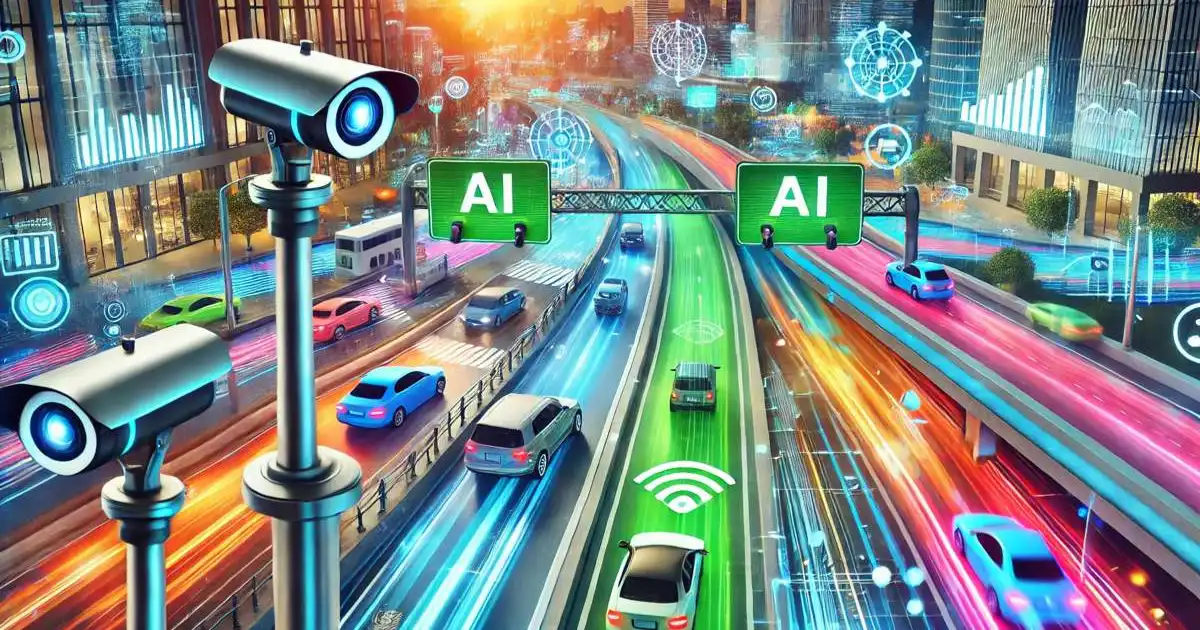
If you’ve ever been stuck at a traffic light wondering why the light takes forever to change, you’ve experienced the problem smart traffic management aims to solve. Cities around the world are growing faster than their roads, and traditional traffic systems fixed-time signals, basic sensors, and human-operated monitoring just don’t cut it anymore. AI is changing the game by making traffic systems not just reactive but predictive and adaptive.
In my experience, the biggest misconception is that AI traffic systems magically eliminate congestion. They don’t. What they do is process mountains of real-time data, learn patterns, and adjust traffic flow in ways humans alone couldn’t manage. Think of it like a nervous conductor directing an orchestra of cars, buses, and pedestrians, constantly recalibrating to keep things from falling apart.
This blog post is about the real-world side of AI traffic management the nuts and bolts of how it actually works, the challenges we face when deploying it, and the practical benefits you can expect. I’ll walk through the workflow, core technologies, functional use cases, real examples, and even the pitfalls we’ve seen in the field. By the end, you should have a clear understanding of not just what AI traffic management is, but how to apply and evaluate it in practice without getting lost in jargon or marketing fluff.
What Is Smart Traffic Management?
Smart traffic management is more than just “turning lights green faster.” At its core, it’s a system designed to monitor, predict, and optimize traffic flow using technology — particularly AI — to make real-time decisions that keep vehicles, pedestrians, and public transport moving efficiently.
I’ve worked on projects where the system integrates cameras, road sensors, GPS data from vehicles, and even weather inputs. The AI doesn’t just react to a single car blocking a lane; it anticipates congestion by analyzing patterns over time. For example, if it notices a sudden slowdown on a highway during morning rush hour, it can adjust nearby traffic lights or reroute vehicles to prevent a backup before it happens.
A smart traffic system is essentially a feedback loop: sensors feed data → AI interprets it → the system executes actions → results are fed back into the system. In practice, this loop runs continuously and at scale, which is why it can outperform human-managed systems.
Importantly, “smart” doesn’t mean perfect. I’ve seen systems misread temporary conditions, like a stalled vehicle or a construction zone, leading to odd signal patterns. The key is that the system learns from these anomalies over time, gradually improving its decision-making.
Diagram Suggestion: A simple loop showing “Sensors → AI Analysis → Actions → Feedback → Sensors.”
Core AI Components & Technologies
From my hands-on work, a lot of people assume AI traffic management is just a fancy app that controls traffic lights. In reality, it’s a combination of multiple AI and tech components working together.
Here’s the breakdown:
-
Data Collection & Sensors
Cameras, loop detectors in roads, LIDAR, radar sensors, GPS from vehicles, and even mobile apps all feed the system data. The more granular the data, the better the AI can predict patterns. I’ve worked on systems where faulty or missing sensors caused more problems than they solved. The AI can’t fix bad data.
-
Computer Vision
Cameras and LIDAR feed into AI models that detect vehicles, pedestrians, cyclists, and incidents like accidents or stalled cars. In practice, lighting, weather, or construction can throw these models off, so robust training on diverse scenarios is critical.
-
Machine Learning Models
These predict traffic volume, congestion spots, and travel times. I’ve used models that combine historical traffic data with real-time inputs to forecast congestion 15–30 minutes ahead enough to make meaningful adjustments.
-
Reinforcement Learning for Optimization
This is where AI “learns by doing.” For example, the system might test different traffic light sequences in a simulation and choose the ones that minimize wait times. Real-world deployment is tricky: changes have to be gradual and monitored to avoid creating chaos.
-
Edge Computing & Cloud Integration
Decisions often need to be made in milliseconds, so some AI runs locally (“on the edge”), while cloud servers handle analytics and long-term learning. I’ve seen projects fail when edge computing capacity was underestimated, causing delays that made the system sluggish.
-
Integration with Traffic Management Platforms
The AI feeds into control software that adjusts lights, variable message signs, or connected vehicles. Practical tip: the software interface needs to be simple enough for human operators to override or fine-tune quickly.
Diagram Suggestion
Layered diagram showing “Data Collection → AI Models → Optimization → Control Actions.”
Real-World Workflow of an AI Traffic Management System
Here’s how an intelligent traffic system typically works in the field. I’ll walk you through the workflow from a practical standpoint.
-
Data Acquisition
Sensors continuously collect vehicle counts, speed, pedestrian flow, and incident reports. GPS data from connected vehicles and apps fills gaps in coverage. In my experience, integrating multiple data sources is essential; relying on a single sensor type almost always leads to blind spots.
-
Data Preprocessing & Cleaning
Raw data is messy cameras get blocked, GPS signals drop, loop detectors fail. AI preprocessing cleans, filters, and normalizes this data. Without this step, predictions go haywire. I’ve seen early deployments fail because teams underestimated how much preprocessing was required.
-
Traffic State Estimation
AI models then estimate current traffic conditions across the network, not just at specific intersections. This includes speed, density, congestion hotspots, and queue lengths.
-
Prediction & Forecasting
Machine learning models predict traffic patterns minutes to hours ahead. For example, the system can forecast congestion near a school during morning drop-off or anticipate bottlenecks from an event at a stadium.
-
Decision-Making & Optimization
Using reinforcement learning or heuristic algorithms, the system determines optimal actions:
-
Adjusting traffic signal timing
-
Changing lane priorities
-
Sending alerts to connected vehicles or dynamic signs
-
Coordinating public transit schedules
I’ve worked on projects where poorly tuned reward functions caused the AI to “game the system,” favoring arterial roads and creating side-street congestion. Careful calibration is critical.
-
-
Execution & Monitoring
Commands are sent to traffic lights, signs, or vehicle systems. Human operators supervise, ready to intervene. Continuous monitoring ensures anomalies are caught. For example, during a snowstorm, manual override may be necessary because AI predictions based on historical data fail.
-
Learning Loop
After execution, outcomes feed back into the system to refine predictions and strategies. This continuous learning improves efficiency over time but requires careful version control and monitoring to prevent regressions.
Diagram Suggestion
Workflow chart showing “Data Collection → Preprocessing → State Estimation → Prediction → Optimization → Execution → Feedback Loop.”
Key Functional Use Cases
In the field, AI traffic systems are used for several core functions:
-
Traffic Signal Optimization
Adjusting green and red light durations dynamically. In one project I handled, this reduced average intersection wait times by 20–30% during peak hours.
-
Incident Detection & Response
AI detects accidents, stalled vehicles, or sudden congestion. This triggers alerts to operators, emergency services, or variable message signs. I once saw a system detect a stalled truck on a highway ramp before any human noticed, preventing a multi-car pileup.
-
Adaptive Routing
Connected vehicles and navigation apps can receive real-time rerouting suggestions to avoid congestion. The tricky part is ensuring reroutes don’t simply shift congestion to side streets something we constantly monitor.
-
Public Transit Coordination
Buses and trams can get signal priority, improving schedule adherence. This is especially valuable in cities where buses share lanes with cars. In practice, balancing bus priority with general traffic flow requires careful tuning.
-
Pedestrian & Cyclist Safety
AI can predict when crosswalks need longer signal times for crowded pedestrian flows or adjust cyclist-specific signals. I’ve seen AI prevent accidents at intersections that were historically dangerous during peak pedestrian hours.
-
Environmental Impact Management
By smoothing traffic flow, AI reduces stop-and-go driving, which lowers fuel consumption and emissions. In one deployment, measured NOx levels dropped significantly after AI traffic signal optimization.
Diagram Suggestion
Table or infographic linking each use case to AI function and real-world outcome.
Real-World Examples
Several cities have successfully implemented AI traffic systems:
-
Los Angeles, USA
The city uses an AI system called ATSAC (Automated Traffic Surveillance and Control). It monitors over 4,500 intersections, adjusting signal timing dynamically. In my experience reviewing case studies, LA saw improved traffic flow, though edge cases like construction zones still required human intervention.
-
Hangzhou, China
Alibaba’s AI City platform controls traffic with computer vision and predictive models. During peak hours, AI reroutes vehicles before congestion forms. I’ve studied similar implementations and noted that integrating e-commerce delivery vehicles into the system posed unique challenges.
-
Barcelona, Spain
Their smart traffic project integrates public transport, parking, and pedestrian flows. AI manages lights and predicts congestion near tourist areas. Real-world deployments emphasized iterative testing; initial AI recommendations often needed manual adjustment before scaling.
-
Singapore
The city-state uses predictive AI to manage expressways and urban intersections. Adaptive signals and real-time traffic analytics reduce congestion during peak hours. I’ve seen that early deployments struggled with mixed traffic types cars, buses, bicycles highlighting the need for robust multi-modal models.
Diagram Suggestion
Map showing cities with AI traffic systems, with icons for key features (signals, predictive routing, public transport integration).
Benefits of AI in Traffic Management
AI traffic management offers tangible benefits, but it’s important to keep expectations realistic:
-
Reduced Congestion
Smart signal timing and predictive rerouting reduce bottlenecks. In my experience, 15–30% reductions in travel time are achievable in well-instrumented cities.
-
Improved Safety
AI identifies incidents faster than human monitoring alone, potentially preventing accidents.
-
Public Transport Efficiency
Buses and trams maintain schedules better with signal prioritization.
-
Lower Emissions
Fewer stops and smoother traffic flow reduce fuel consumption and pollution.
-
Data-Driven Planning
Historical and real-time data allows cities to plan road expansions or maintenance more effectively.
The biggest benefit, in my opinion, isn’t the AI itself, but the continuous learning loop. The system gets smarter over time, detecting anomalies, improving predictions, and responding faster than static systems could.
Challenges & Limitations
AI traffic systems aren’t magic. Real-world deployments face challenges:
-
Data Quality Issues
Broken sensors, occluded cameras, or inaccurate GPS data can mislead AI.
-
Edge Cases
Construction, weather events, or unusual traffic patterns often confuse models. I’ve seen AI misprioritize lights during temporary diversions.
-
Integration Complexity
Connecting AI to existing infrastructure can be a nightmare. Legacy systems often don’t play nice.
-
Human Oversight Needed
Operators must monitor AI actions. Overreliance can backfire.
-
Cost & Maintenance
Sensors, cameras, computing infrastructure, and continuous model updates are expensive.
AI is powerful, but without careful planning, calibration, and monitoring, it can introduce new problems instead of solving old ones.
Future Trends
Looking ahead, AI traffic management is evolving rapidly:
-
Connected and Autonomous Vehicles (CAVs)
AI can coordinate signals with self-driving cars, reducing stop-and-go traffic.
-
Multi-Modal Traffic Management
Integrating bikes, scooters, pedestrians, and public transit for holistic city mobility.
-
Predictive Maintenance
AI predicting when traffic infrastructure will fail, avoiding downtime.
-
Edge AI Improvements
Faster local processing reduces latency, making real-time decisions more reliable.
-
Green AI
Traffic optimization focused on minimizing emissions and energy usage.
In practice, these trends require cities to invest not just in AI, but in infrastructure, policy, and skilled operators. The “smart city” is a long-term project AI is a tool, not a silver bullet.
You Might Be Interested In
Conclusion
AI traffic management is a practical, evolving solution to a stubborn urban problem. In my experience, the key to success is not chasing perfection but embracing continuous learning, careful calibration, and human oversight. AI can reduce congestion, improve safety, and make urban mobility more efficient but only when implemented thoughtfully.
Cities that succeed invest in high-quality data, robust models, and flexible infrastructure, while recognizing the system’s limitations. The future promises even smarter, more integrated traffic systems, but the lessons from today’s deployments are clear: AI works best when it complements human expertise rather than replaces it.
FAQs
What is smart traffic management with AI?
Smart traffic management with AI is a system designed to monitor, analyze, and optimize the flow of traffic in real-time. Unlike traditional traffic systems that operate on fixed schedules, AI-driven systems constantly process data from cameras, sensors, GPS devices, and other sources to make intelligent decisions about signal timing, lane prioritization, and traffic rerouting.
In practice, this means the system can anticipate congestion before it happens and adjust traffic patterns dynamically. I’ve seen these systems adapt to complex scenarios, such as sudden lane closures or surges in pedestrian flow, far faster than a human operator ever could.
How does AI improve traffic signal control?
AI improves traffic signal control by moving from static, one-size-fits-all schedules to adaptive, data-driven decision-making. It analyzes real-time traffic conditions, predicts short-term congestion, and adjusts light timings dynamically to minimize delays.
For example, during peak hours, an AI system might extend green lights on busy arteries while shortening them on quieter streets, balancing the overall flow.
In my experience, the real challenge is tuning the system correctly: poorly designed reward functions or outdated data can cause the AI to favor one route excessively, creating unexpected congestion elsewhere. When done right, AI can reduce waiting times significantly and smooth traffic patterns across the network.
Real-world examples of AI traffic systems
Cities around the world are already using AI to manage traffic more intelligently. Los Angeles uses the ATSAC system to monitor thousands of intersections, adjusting lights dynamically to reduce congestion. Hangzhou in China leverages Alibaba’s AI City platform to reroute vehicles and prevent traffic jams before they occur.
Barcelona integrates AI with public transit and pedestrian flow, while Singapore applies predictive models to manage expressways and urban intersections efficiently. From my experience, each deployment highlights the importance of iterative testing the AI’s first recommendations often need human adjustment before scaling but once tuned, these systems can drastically improve urban mobility.
Main benefits of AI traffic management
The benefits of AI traffic management are both immediate and long-term. In practice, I’ve seen it reduce congestion, cut travel times, and improve the reliability of public transport schedules. Safety also improves because AI can detect incidents, stalled vehicles, or unusual traffic patterns faster than human monitoring alone.
Additionally, smoother traffic flow reduces fuel consumption and emissions, contributing to environmental goals. Beyond these, AI provides cities with actionable insights for planning road expansions, maintenance schedules, and policy decisions, allowing traffic management to become proactive rather than reactive.
Challenges in implementing AI traffic systems
Despite the advantages, implementing AI traffic systems is far from simple. Data quality is a major hurdle: faulty sensors, blocked cameras, or incomplete GPS data can mislead the AI. Edge cases such as construction zones, accidents, or unusual events often confuse the system, requiring human oversight. Integrating AI with existing infrastructure can also be complicated, especially in cities with legacy traffic control systems.
Finally, the cost of deployment and maintenance from sensors and cameras to computing resources and model updates is significant. In my experience, the most successful projects are those that plan for these challenges upfront, combining AI’s capabilities with human expertise rather than relying solely on automation.
