

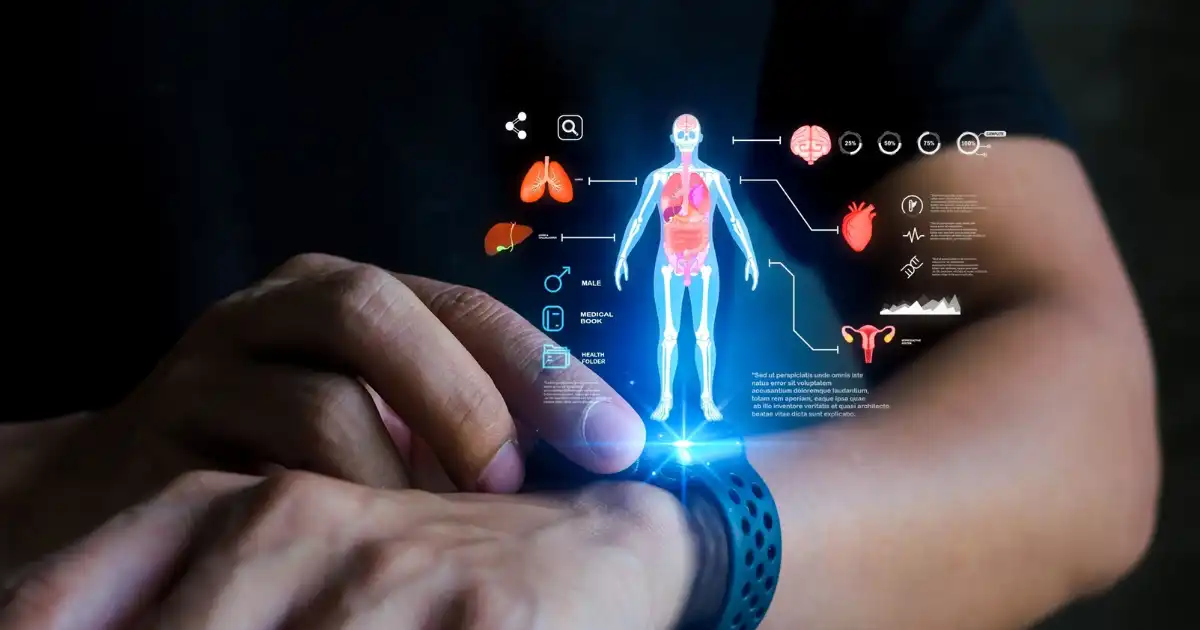
A smartwatch sitting on your wrist looks simple. It shows notifications, counts steps, and maybe reminds you to stand up after sitting too long. How Wearable Technology Tracks Health?
Many people assume wearable devices directly “know” things like their heart rate, sleep quality, or stress level. That is not actually how it works. A smartwatch does not look inside your body or understand your health the way a doctor does. Instead, it collects physical signals from your body, converts those signals into digital information, and uses software to find patterns that can be useful.
Your body produces signals → Sensors detect changes → Data is processed → Algorithms analyze patterns → The device provides health insights.
In my experience, this is the biggest misunderstanding people have about smartwatches and fitness trackers. They think the device is measuring everything directly. In reality, wearable health technology is a combination of sensors, mathematics, software models, and years of data analysis designed to make reasonable estimates from limited information.
What Is Wearable Technology for Health Tracking?
Wearable technology for health tracking refers to electronic devices designed to be worn on the body while collecting information about physical activity and health-related signals.
The most common examples are smartwatches, fitness bands, and smart rings. However, the category also includes smart clothing with built-in sensors and medical wearables designed for more specific monitoring purposes.
A smartwatch used for health monitoring may include several small components working together:
A sensor system that captures body signals.
A processor that converts and analyzes collected information.
Software algorithms that identify patterns.
A mobile app that displays health reports and trends.
Modern wearable health devices are used for many reasons. Some people use them to track workouts, monitor daily movement, or understand sleep habits. Others use them to observe long-term patterns such as resting heart rate changes or recovery levels after exercise.
The important point is that wearable devices are mainly designed for awareness and tracking. They help people understand their habits and notice changes over time, but they are not replacements for medical equipment or professional medical advice.
For example, a smartwatch may show that your resting heart rate has changed compared with your normal pattern. That information can be useful, but the device cannot determine the exact reason behind that change.
How Do Wearable Devices Collect Health Data?
The process begins with sensors. These tiny electronic components are the part of the device that interacts with your body and surroundings.
A wearable device does not collect health information in the same way a hospital machine does. Instead, it continuously collects small measurements throughout the day and uses software to interpret them.
Sensors Capture Physical Signals
Your body constantly creates measurable changes. Your heart pumps blood, your body moves, your skin temperature changes, and your cells use oxygen. Wearable sensors detect some of these physical changes.
For example, a smartwatch can detect:
Changes in blood flow.
Body movement.
Skin temperature variations.
Electrical signals from the heart.
Light absorption related to oxygen levels.
However, sensors themselves are not intelligent. They do not understand health. They only detect physical changes and produce raw measurements.
A heart rate sensor does not actually see your heartbeat. It detects changes caused by blood movement under your skin and converts those changes into data that software can analyze.
Sensors Convert Signals Into Digital Data
Once sensors capture physical changes, the device converts those signals into numbers that a computer can process.
Imagine an optical heart rate sensor on the back of a smartwatch. The sensor sends light into your skin and measures how that light changes as blood moves through your veins. The device then uses those changes to estimate your heart rate.
The same idea applies to movement sensors. An accelerometer does not understand that you are walking your dog or climbing stairs. It only detects changes in motion and direction. Software then interprets those patterns as walking, running, or another activity.
Software Converts Data Into Health Information
Raw sensor data by itself is not very useful. A wearable device needs software to turn measurements into information people can understand.
The device processes raw data into things like:
Heart rate readings.
Sleep reports.
Exercise summaries.
Recovery scores.
Activity trends.
This is where the software becomes just as important as the hardware. A good sensor can collect information, but the algorithms determine how that information becomes a meaningful result.
What Sensors Do Wearable Health Devices Use?
Different wearable devices use different sensor combinations depending on their purpose. A basic fitness tracker may focus mainly on movement and heart rate, while advanced smartwatches may include additional sensors for more detailed health monitoring.
Optical Heart Rate Sensors and PPG Technology
One of the most common sensors in wearable health devices is the optical heart rate sensor, which uses a method called photoplethysmography, often shortened to PPG.
These sensors usually contain small LED lights on the back of the device. The lights shine into the skin, and the sensor measures how much light is reflected back.
Blood absorbs and reflects light differently depending on how much blood is flowing through the area. Because blood flow changes with each heartbeat, the sensor can detect these variations and estimate heart rate.
This technology allows smartwatches to provide features such as:
Resting heart rate monitoring.
Exercise heart rate tracking.
Heart rate zones during workouts.
Heart rate variability measurements.
However, accuracy depends on real-world conditions.
A loose watch strap, incorrect placement, heavy movement during exercise, or poor skin contact can affect readings. This is why a smartwatch may be very accurate during normal daily activity but less reliable during intense movement.
Accelerometers and Gyroscopes
Movement sensors are another important part of wearable health technology.
Accelerometers measure changes in speed and movement direction. Gyroscopes detect rotation and orientation changes.
Together, these sensors help devices understand physical activity.
They allow fitness trackers to estimate:
Steps taken.
Walking patterns.
Running activity.
Workout movements.
Body position during sleep.
Movement tracking is generally easier than measuring internal health conditions because motion creates clearer signals. If your wrist moves in a repeated pattern, the device can usually identify that activity with reasonable accuracy.
However, even movement tracking is not perfect. A device may count some arm movements as steps or miss activities where your wrist stays still.
Blood Oxygen Sensors (SpO2)
Many modern smartwatches include blood oxygen monitoring using red and infrared light.
These sensors estimate oxygen levels by analyzing how blood absorbs different types of light. The device uses this information to calculate an approximate oxygen saturation level.
Blood oxygen monitoring can be useful for observing patterns, especially when combined with other health information.
However, it is important to understand the limitation. These sensors are not the same as medical oxygen testing equipment used in clinical environments.
Factors such as movement, poor contact, and environmental conditions can influence readings.
Temperature Sensors
Temperature sensors measure changes in skin temperature.
Wearable devices use this information for wellness insights, recovery tracking, and detecting changes from a person’s normal baseline.
One common misunderstanding is that skin temperature is the same as body temperature. It is not.
Skin temperature changes based on many factors, including room temperature, clothing, activity, and blood circulation. Because of this, wearable temperature measurements are usually more useful for tracking trends rather than making medical conclusions.
ECG Sensors
Some advanced smartwatches include ECG sensors that measure electrical activity from the heart.
Unlike optical sensors that estimate heart rate through blood flow, ECG sensors detect electrical signals produced by the heart.
These features can help users collect additional information about heart rhythm patterns.
However, ECG features on consumer wearables are designed for awareness and monitoring. They do not replace professional cardiac testing or diagnose health conditions on their own.
How Wearable Technology Turns Data Into Health Insights
Collecting data is only the first step in wearable health technology. The real challenge is turning thousands of small measurements into information that people can understand and use.
A smartwatch may collect heart rate information every few seconds, record movement throughout the day, monitor changes in skin temperature, and observe sleep patterns during the night. On their own, these measurements are just numbers. The device needs software and algorithms to understand what those numbers might mean.
This is where the difference between a simple sensor and a smart health device becomes clear.
The sensors collect information, but algorithms create meaning from that information.
Data Collection: Gathering Small Signals Throughout the Day
Wearable devices continuously collect small pieces of information while you wear them.
For example, a smartwatch may record:
Heart rate changes during rest and exercise.
Movement patterns while walking, running, or sleeping.
Changes in skin temperature.
Sleep duration and interruptions.
Exercise intensity and recovery patterns.
The device does not need one perfect measurement to understand your habits. Instead, it collects many small measurements and looks for patterns over time.
This is similar to how a person understands their own fitness progress. One workout does not tell you everything about your health. A pattern of activity over weeks or months gives a much clearer picture.
The same idea applies to wearable health devices. Long-term trends are often more useful than a single reading.
A slightly higher heart rate on one afternoon may not mean anything important. But if your resting heart rate consistently changes from your normal pattern, the information may be worth paying attention to.
Algorithms Analyze Patterns
After collecting raw data, the wearable device uses algorithms to analyze it.
An algorithm is simply a set of instructions that helps software process information and identify patterns.
For example, the device receives movement data from accelerometers and gyroscopes. The algorithm compares those movement patterns with known examples of walking, running, cycling, or other activities.
The same process happens with sleep tracking. The device cannot directly see when you fall asleep or know exactly which sleep stage you are experiencing. Instead, it combines signals such as movement, heart rate changes, and other measurements to estimate sleep behaviour.
This is an important point that many people misunderstand.
Wearable devices are usually making educated estimates based on available signals. They are not directly observing every biological process happening inside your body.
The Role of Artificial Intelligence in Wearable Technology
Artificial intelligence has become an important part of modern wearable health technology.
AI helps wearable devices process large amounts of health data and identify patterns that would be difficult to analyze manually.
For example, AI can help with:
Recognizing different types of activities.
Estimating sleep patterns.
Identifying changes from normal behaviour.
Creating personalized insights.
Improving exercise recommendations.
However, AI does not magically make a smartwatch a medical laboratory.
The quality of AI results depends on the quality of the data collected. If sensors provide limited or inaccurate information, the software cannot produce perfect results.
In my experience, this is where many people have unrealistic expectations. They hear that a device uses AI and assume it can understand everything about their health. In reality, AI improves interpretation, but it still works within the limits of the sensors and available information.
What Health Metrics Can Wearable Devices Track?
Modern wearable health devices can monitor a wide range of measurements. The exact features depend on the device model, but most focus on fitness, heart activity, sleep, and general wellness.
Fitness Metrics
Fitness tracking is one of the most common uses of wearable devices.
Most fitness trackers and smartwatches can monitor basic activity information such as:
Steps taken.
Distance travelled.
Calories burned estimates.
Exercise duration.
Workout intensity.
These measurements help users understand their daily activity levels and maintain consistent exercise habits.
However, some measurements are easier to estimate than others.
Step counting is usually reliable because movement patterns are relatively easy to detect. Calories burned are much more complicated because they depend on factors such as age, body composition, fitness level, metabolism, and exercise intensity.
A wearable device can provide an estimate, but it cannot know your exact calorie usage.
Heart Health Metrics
Heart monitoring is one of the most advanced areas of wearable health technology.
Many smartwatches can track:
Heart rate.
Resting heart rate.
Heart rate variability.
ECG readings.
Heart rate during workouts.
Heart rate monitoring helps users understand how their body responds to activity and rest.
For example, someone who regularly exercises may notice that their resting heart rate changes as their fitness improves.
Heart rate variability is another measurement that has become popular. It looks at changes in the timing between heartbeats and is often used as part of recovery and wellness tracking.
However, these measurements should be viewed as information, not a diagnosis.
A wearable device can show changes, but understanding the reason behind those changes often requires additional context.
Sleep Metrics
Sleep tracking technology has become a major feature of wearable health devices.
During sleep, wearables monitor signals such as movement and heart rate patterns to estimate sleep behaviour.
They can provide information about:
Total sleep time.
Sleep consistency.
Estimated sleep stages.
Night-time interruptions.
Sleep quality trends.
Sleep tracking can help users notice habits that affect rest. For example, someone may discover that their sleep quality changes when they exercise late at night or use screens before bed.
However, sleep stage accuracy is more complicated than many people realize.
A wearable device cannot directly measure brain activity like professional sleep monitoring equipment. Instead, it estimates sleep stages using available signals.
The data can be useful for identifying patterns, but it should not be treated as a perfect measurement.
Other Health Measurements
Modern smart health devices may also track additional information, including:
Blood oxygen levels.
Skin temperature changes.
Stress estimates.
Recovery scores.
Fall detection.
These features continue to improve as sensor technology and software algorithms develop.
The key is understanding what these measurements represent. A recovery score, for example, is not a direct measurement of how recovered your body is. It is an estimate created from different signals such as activity, sleep, and heart-related data.
How Accurate Are Wearable Health Trackers?
Accuracy is one of the biggest questions people ask before buying a wearable device.
The answer depends on what the device is measuring.
Some measurements are generally easier and more reliable, while others involve more estimation.
Step counting and basic movement tracking are usually among the strongest features because motion sensors can detect physical movement clearly.
Heart rate monitoring during normal activity is also often reasonably accurate, especially when the device fits properly.
Other measurements are more challenging.
Calories burned, stress levels, sleep stages, and recovery scores involve more complex calculations because they depend on many factors.
Accuracy can change because of:
Sensor quality.
Device placement.
Movement during measurement.
Individual body differences.
Software algorithms.
A wearable device works best when users understand it as a tool for tracking trends rather than a perfect medical instrument.
The value comes from seeing patterns over time.
For example, noticing that your activity level has decreased for several weeks may encourage healthier habits. Seeing changes in your sleep schedule may help you improve your routine.
The device provides information. How you interpret and use that information matters just as much.
You Might Be Interested In
- Why Wireless Gadgets Are So Popular?
- How Smart Gadgets Make Life Easier?
- How Smart Home Devices Work Together?
- How Consumer Technology Changes Daily Life?
Conclusion
Wearable technology has changed the way people understand their daily health by making personal data easier to collect and observe. A smartwatch or fitness tracker does not directly see what is happening inside your body. Instead, it collects physical signals through sensors, converts those signals into digital data, and uses software algorithms to create useful health insights.
The real strength of wearable health devices is not perfect measurement. It is continuous tracking. They help users notice patterns in activity, heart rate, sleep, and recovery that may be difficult to recognize without regular monitoring.
At the same time, it is important to use this information realistically. Wearable devices are excellent tools for awareness, fitness improvement, and understanding personal habits, but they are not replacements for medical equipment or professional diagnosis
FAQs
How does wearable technology track health?
Wearable technology tracks health by collecting physical signals from the body using built-in sensors. Devices such as smartwatches, fitness trackers, and smart rings use sensors to detect changes in movement, heart activity, blood flow, skin temperature, and other measurable signals. These sensors do not directly understand health conditions. They simply collect raw information that is converted into digital data.
After collecting data, the device uses software algorithms and AI models to analyze patterns and create health insights. For example, a smartwatch can estimate heart rate by analyzing changes in blood flow using optical sensors, or estimate sleep patterns by combining movement and heart rate information. The results help users understand trends in their health and fitness, but they should be viewed as estimates rather than complete medical measurements.
What sensors are used in wearable health devices?
Wearable health devices use different sensors depending on their features and purpose. Common sensors include optical heart rate sensors that use light to estimate blood flow changes, accelerometers and gyroscopes that detect movement, temperature sensors that monitor skin temperature changes, and blood oxygen sensors that estimate oxygen saturation levels.
Some advanced smartwatches also include ECG sensors that measure electrical activity from the heart. These sensors allow devices to provide additional health information, but they still have limitations. They are designed for tracking and awareness, not for replacing professional medical equipment or diagnosing health conditions.
Are wearable health trackers accurate?
The accuracy of wearable health trackers depends on what they are measuring. Some measurements, such as step counting, basic movement tracking, and heart rate during normal activity, are usually more reliable because the signals are easier for sensors to detect. Wearables can be very useful for understanding activity levels and observing changes over time.
Other measurements, such as calories burned, stress levels, and sleep stages, are more difficult to calculate because they depend on many factors. Accuracy can be affected by sensor quality, device placement, movement, and individual differences between users. Wearable devices are best used for identifying patterns and trends rather than expecting perfect medical-level accuracy.
Can a smartwatch detect health problems?
A smartwatch can sometimes identify changes in health-related patterns, but it cannot diagnose health problems by itself. Features such as heart rate monitoring, ECG readings, irregular rhythm notifications, and activity tracking can provide information that may help users notice something unusual about their body.
However, a smartwatch does not understand the complete medical situation behind a measurement. A change in heart rate, sleep pattern, or activity level can happen for many different reasons. If a wearable device shows unusual results or concerns, professional medical advice is still needed to understand what those changes actually mean.
How do smartwatches track sleep?
Smartwatches track sleep by combining information from multiple sensors, mainly movement sensors and heart rate sensors. During sleep, the device monitors changes in movement, heart rate patterns, and sometimes other signals such as skin temperature to estimate when a person is asleep and how their sleep may be structured.
Most smartwatches estimate different sleep stages, including light sleep, deep sleep, and REM sleep, but they do not directly measure brain activity like professional sleep monitoring equipment. This means sleep tracking is useful for identifying habits and patterns, but the results should be understood as estimates rather than exact measurements.
Do wearable devices monitor health continuously?
Many wearable devices are designed to monitor health information continuously while they are being worn. They can collect frequent measurements throughout the day, such as heart rate changes, movement levels, activity patterns, and sometimes blood oxygen or temperature information.
Continuous monitoring is valuable because it creates a larger picture of a person’s daily habits instead of relying on a single measurement. However, continuous tracking does not mean the device is constantly performing medical tests. It is collecting signals and analyzing patterns to provide general health insights, not replacing clinical monitoring systems.
